Governance, Risk, and Compliance · Third-Party Risk Management · STORM GRC
Third-party risk is no longer a peripheral concern; it’s a core component of how organisations operate.
As businesses increasingly rely on external vendors, suppliers, and service providers, they also inherit risks they don’t fully control. In many cases, organisations are only as secure as their weakest supplier.
This is why Third-Party Risk Management (TPRM) has become essential.
What is Third-Party Risk Management (TPRM)?
Third-Party Risk Management (TPRM) is the process of identifying, assessing, monitoring, and managing risks introduced by external parties throughout their lifecycle—from onboarding and due diligence to continuous monitoring and offboarding.
It ensures that third parties meet security, compliance, and operational requirements at every stage of engagement.
Why Third-Party Risk Management Is Critical Today
Modern business operations depend heavily on third parties.
Organisations rely on external providers for:
This growing dependency creates a distributed risk environment where organisations no longer have full control over their operational risk. In practice, a single weak supplier can introduce risk across the entire organisation. This gap between perceived and actual risk is one of the main challenges in managing third-party ecosystems.
Key Risks Introduced by Third Parties
Third-party relationships introduce multiple layers of risk:
As third-party ecosystems expand, these risks become harder to track, assess, and manage consistently.
The Multi-Regulatory Challenge
Organisations today must comply with multiple frameworks such as ISO 27001, NIS2, DORA, GDPR, and others.
Each introduces requirements related to third-party risk, including:
Clear contractual obligations and defined security requirements are essential to enforce accountability across third parties.
Managing these requirements manually across multiple frameworks can quickly become difficult to sustain at scale, especially as vendor numbers grow and requirements overlap. Traditional point-in-time assessments are no longer sufficient, as vendor risk can change rapidly over time.
Why Traditional TPRM Approaches Fall Short
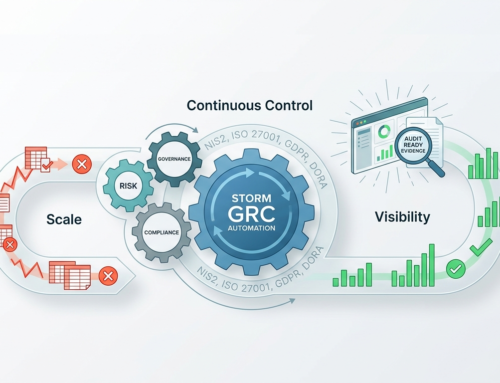
Despite the importance of TPRM, many organisations still rely on spreadsheets, emails, and disconnected tools.
This leads to:
In many cases, the process itself becomes the biggest source of risk.
This is where most TPRM programmes begin to break down.
What a Modern TPRM Platform Should Deliver
To manage third-party risk effectively, organisations need more than periodic assessments. They need a structured, continuous, and scalable approach.
A modern TPRM platform should provide:
Not all suppliers carry the same level of risk; critical vendors require deeper due diligence, continuous monitoring, and stricter controls.
Most importantly, it should replace fragmented processes with a single, consistent view of third-party risk.

At ICT Protect, we deliver a structured TPRM approach through our STORM GRC platform, helping organizations manage third-party risk and simplify compliance.
How STORM GRC Enables Effective TPRM
This is where STORM GRC provides a structured and scalable solution.
STORM GRC enables organisations to manage third-party risk in a structured, scalable, and continuously managed way, covering the entire vendor lifecycle from onboarding and risk assessment to ongoing monitoring, audit readiness, and remediation.
1. Centralised Third-Party Management
STORM provides a unified repository for all third parties, giving organisations full visibility across their vendor ecosystem.
Teams can maintain a centralised supplier inventory, apply risk-based classification, and enrich supplier data through integrations with external security rating services. This eliminates fragmented tracking and ensures a consistent, up-to-date view of vendor risk.
2. Multi-Framework Risk and Compliance Alignment
STORM GRC supports multiple international standards and regulations, including ISO 27001, NIST CSF, SOC 2, DORA, NIS2, and GDPR.
Supplier-related controls, risks, and assessments can be mapped across multiple frameworks simultaneously, reducing duplication and ensuring consistency across regulatory requirements. This allows organisations to maintain a unified compliance posture across all vendors.
3. Continuous Monitoring and Risk Visibility
STORM GRC enables automated supplier risk scoring and structured assessment workflows, supported by real-time dashboards and continuous data updates.
The platform integrates external threat intelligence sources, including tools such as BitSight and FortiRecon, to continuously evaluate supplier security posture and detect emerging risks. This ensures risk visibility is no longer limited to periodic assessments but remains continuously updated.
4. Audit Readiness and Traceability
STORM supports the full audit lifecycle, including audit planning, findings management, corrective actions, and evidence collection.
Supplier-related documentation, assessments, and compliance data are centrally managed and directly linked to audit requirements. This ensures full traceability and significantly reduces the effort required for regulatory reviews and third-party audits.
5. Integrated GRC Capabilities
STORM GRC brings together all core GRC domains (risk, compliance, audit, incidents, assets, suppliers, and business continuity) into a single platform.
This allows organisations to link risks to suppliers and assets, trigger remediation actions from audit findings, and align policies and controls across the organisation. By connecting these domains, STORM enables a consistent and coordinated approach to risk and compliance management.
From Reactive Vendor Management to Proactive Risk Control
Without a structured approach to TPRM, organisations often lack a clear, real-time view of third-party risk, making it harder to understand where exposure exists and what needs attention.
By adopting STORM GRC, organisations move away from reactive, checklist-driven processes and take a more proactive approach to managing their third-party ecosystem. They gain:
As third-party ecosystems become more interconnected and complex, organisations need continuous visibility and control to manage exposure effectively and avoid critical blind spots.
To see how this works in practice, request a demo or get in touch with our team to learn more.